Malgudi, bathed in the laziness of a humid afternoon, thrummed with the cicadas’ incessant song. Venkatrao, draped in a threadbare dhoti that clung damply to his limbs, sat with his forehead creased against the rough grain of a wooden bench. In his right hand, he gingerly fingered a crumpled rupee note, its crispness an affront to the sun-bleached monotony of his life.
The money sat heavy, a lodestone attracting a swarm of justifications. It wasn’t a stolen windfall, no sir. Merely a misplaced offering, a stray feather from the temple goddess draped upon his humble doorstep by a careless crow. A celestial nudge, surely, not a temptation.
Venkatrao, a man of modest needs and even more modest means, had dreamt of this note’s possibilities. A fragrant cup of filter coffee at Supposedly Coffee House, the clink of its stainless steel tumbler a symphony against the mundane clatter of his existence. Perhaps even a single, plump samosa, its oily heart bursting with spiced potatoes – a forbidden luxury.
His wife, Saraswati, stirred within him like a reproachful ghee lamp. Her bony fingers, etched with the maps of their shared austerity, would count the wrinkles on the note with disapproval. Her tongue, sharp as a curry leaf, would dissect his flimsy justifications, leaving him stripped bare in the sun-drenched courtyard.
Yet, the note persisted, whispering of possibilities. Venkatrao could almost smell the coffee, its bitter aroma weaving through the dust. He could taste the crispness of the samosa, feel its greasy warmth slide down his throat. A shiver of longing danced down his spine, a rebellion against the monotonous thrum of the cicadas.
He reasoned with himself, the arguments tumbling forth like poorly stacked mangoes. It was a loan, he’d convince Saraswati. A temporary indulgence, to be repaid with the next meager pay from the mill. Besides, wasn’t happiness a right, even for a threadbare soul like him?
As the sun dipped towards the mango trees, casting long shadows across the dusty lanes, Venkatrao’s resolve began to fray. The note crumpled in his fist, a talisman against the gnawing guilt. He rose, his dhoti flapping like a moth’s wings, and took a tentative step towards Supposedly Coffee House.
But just as he crossed the threshold, a small hand slipped into his. His daughter, Lakshmi, eyes wide and hopeful, looked up at him. “Papa,” she chirped, “Can we buy jalebis today?”
The question, innocent and pure, shattered the mirage of his justifications. Venkatrao looked at the crumpled note, the samosa and the coffee dissolving into smoke before him. In his daughter’s eyes, he saw not just hunger, but trust, an anchor in the turbulent sea of his desires.
With a sigh, he crumpled the note further and tucked it back into his pocket. This loan, he knew, would have to wait. Happiness, he realised, wasn’t just a cup of coffee, but the shared sweetness of a jalebi with his little girl. And as they walked towards the jalebi vendor, the cicadas seemed to sing a different tune, one of contentment and simple joys, sweeter than any stolen sip of coffee.
Thus, Venkatrao returned home, the rupee note a reminder of his victory over temptation, a silent pact with the goddess and his own conscience. The samosa remained a dream, the coffee a distant aroma, but in his daughter’s smile, he tasted a sweetness that lingered long after the jalebis had vanished. And the cicadas, finally, seemed to sing in perfect harmony with the quiet contentment of his heart.
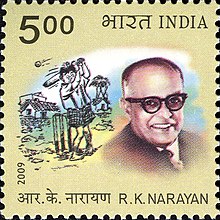
(The third in my series of pastiche is dedicated to none other than R.K. Narayan)
 Saugata Chakraborty
Leave a comment