“Tatha always complains that my cases revolve around individuals of overseas origins. It’s high time I break the myth,” Sutanu said, taking a sip of black coffee from his black mug. Our meets had become an early casualty of the series of lockdowns. After shifting the goalpost twice, we were facing each other the first time over Zoom, agreeing to discuss everything except COVID. There was another difference, though. Two more of our M. Com. batch mates had connected for the session- Promit Ray, the seasoned bureaucrat in the West Bengal Government and Aliya, one of the few entrepreneurs our batch has produced.
“Go ahead, I have only written what I have seen,” I kept the disclaimer short lest it changed the course of the chat. Promit and Aliya too joined in, asking Sutanu to proceed.
“Well, all of you might remember the news from 2016. The death of Wahid Mahajan in a crossfire at Jhargram.”
“Yes, I thought there were many a question left unanswered there,” Aliya sounded skeptical.
“True, I mean the way the media had made it look, anybody would have questioned the validity of the claims made by police, but a later investigation could not prove any foul play, so I will leave it at that. Today, I am only going to tell you how and why we apprehended Wahid,” Sutanu continued in his characteristic calm.
“Inspector Arnab Joardar had undergone induction with me. In the spate of transfers between the Kolkata and the West Bengal Police in 2014, he found himself transported to West Midnapore while I somehow survived to continue at the Homicide Squad. When I got the call from Arnab that evening, he was in a dilemma.
He had returned late the previous night from a week-long vacation with his family in Kolkata. After a quick nap, as he was getting ready to resume duty, the call came from one of the ASIs of his station. The police had recovered the body of an unknown 25-year-old lady from a high drain behind the house of Sekh Lallan of Kuila village early morning. Since Arnab had arrived late, the Circle Inspector had asked others not to bother him till nine and had himself left for Kuila. By the time Arnab could join him at ten, they had already dispatched the body to Jhargram for postmortem. A boy, while defecating in the open field beside the Sekh residence, had seen the couple dumping the body into the drain, but kept mum. By the time there was enough sunlight for everybody in the neighbourhood to notice the dead woman, Lallan was gone from the village. The police believed that someone had strangled the victim with a gamchha that was left attached to her neck.
Police took Shefali, Lallan’s wife and alleged accomplice in the murder, along with seven others, into custody. CI Mr. Bhanja had, before leaving for the Headquarters, asked Arnab to lodge a case against Lallan and Shefali. But, as Arnab continued with the oral enquiry with the other villagers, an important information had emerged.
It was the truth that Lallan had several pending cases of kidnapping, extortion, and sexual abuse against him. But Rustam Hussain was no different. A long-standing adversary of the Sekhs who would stop at nothing to score a point against Lallan, Rustam was also on the run.
“Is that why your friend, this Inspector Joardar, was in a dilemma?” Promit asked as Sutanu had stopped for another sip.
“That had made Arnab curious, but he was still not suspecting Rustam. He was more concerned with the bigger picture- the reason that he got me involved in the case.”
“The bigger picture?” I lacked in restraining my curiosity.
“Yes, Arnab remembered that in the six months before the Kuila incident, individuals had discovered three other bodies dumped at different locations in the district.”
“A serial killer?” it was Aliya’s turn to pop the question.
“And Sutanu will tell you why the killer is not to be one. Let’s hear it out,” I told from my experience involving a murderous jockey and his cousin that Sutanu had solved in his last few days with the Homicide Squad.
“Arnab had suspected that. Presence of a serial killer in the district is not unheard of, but the Police there, especially at the ground level, had little or no acumen for dealing with such a criminal mind. If Arnab was right, our support could have become critical. He had another reason to believe that Lallan was not the perpetrator. He was way too smart to dump the body at his own backyard if he had committed the murder.
I told Arnab to talk to the SP to buy some time before lodging the case against the Sekh couple. I knew the young IPS Anand Trivedi, a protégé of our Commissioner, who had till the last month been SP, CID. The familiarity gave me confidence that he would understand what Arnab had to say. Half an hour later, Arnab again called to tell that he had got time till that night to come up with any other lead. There was another development. An inexpensive mobile device, which was found lying beside the body, had become drenched and malfunctioned. After hours of trying, the Binpur Police had activated the phone. The call history had one number marked as “Abbu”. Arnab had called the number from the girls’ mobile. The respondent had identified himself as the father of Fatiha Alam, the girl to whom the mobile belonged. He said he was a resident of Bankura while Fatiha worked in Kolkata at a tailoring unit. Arnab told the man Ghazi that the girl had met with an accident and was getting treated at Binpur Health Centre. Ghazi had said he would start for Binpur. Arnab was expecting him to reach before the light dies for the day.
‘That’s at least four hours from now. Do you have the coordinates of the tailoring unit that Fatiha works for?’ I asked him. You can call it superstition, but until Ghazi identified the body as that of his daughter, I couldn’t mention her in the past tense.” Sutanu said.
“Was the body not Fatiha’s?” Aliya’s mind raced with anticipation as she sought answers.
“Please hold your horses. Arnab did not have the location for her workplace, but Ghazi had given him a Kolkata landline number of the business. He could have called them, but wanted to know if I could chip in with a visit to the workshop.”
“And you agreed?” Promit asked.
“Yes, I had little on my desk, and Arnab had only a few hours left before his deadline. I had to act fast. The directory search for the landline number had led us to the Kasba address of Istanbul Garments. It turned out to be a single-storied house with a signboard outside displaying the name of the organization in white calligraphic lettering against a bright red background. A small verandah led to the small but swanky reception. Both me and Rajesh, an ASI were in plain clothes, but the way the girl at the reception stood up and greeted us had made it clear she could see the patrol vehicle we had descended from on the CCTV monitor. It helped in cutting down on formalities.
“That’s Fatiha, b-but is she dead?” Saima, the receptionist, asked in disbelief when she was shown the image of the corpse received on WhatsApp from Arnab.
“Yes. Were you friend with her?”
“Both of us have been working here for the past couple of years, though she was in production. But she did not appear to be sick or anything. How did it happen?”
“Will tell you everything you need to know, but before that, I would like to have some more information. When did Fatiha last attend the workshop?”
“The day before; we were closed yesterday. She had asked for a day’s leave today; said she was to go visit her father in Bankura.”
“So, you did not enquire when she had not turned up for work this morning.”
“That’s right, Sir.”
“Had you noticed anything amiss about her in the recent past?”
“Not really, but Friday afternoon, after Sameer had left, she seemed a little unmindful.”
“Who is this Sameer?”
“Oh, he is a nice guy. Fatiha called him a brother. Of late, he used to pay her a visit here often.”
“By any chance, do you have a contact number of this Sameer?”
“No, I never asked.”
“How does he look?” Rajesh had asked, breaking his silence for the first time.
“I think we need not ask for a description; don’t you have the CCTV recordings from last Friday, Saima?” I quipped.
It was Rajesh again who spoke first while we were going through the footage.
“That’s Wahid!” He exclaimed.
“No, that is Sameer,” Saima said, oblivious to the notices that all Police Stations in our state adorned a few years ago featuring the mugshot of Wahid Mahajan. Rajesh and I exchanged glances. We were thinking about the same line. Arnab appeared to be right in not registering a case against Lallan and his wife. Even with the staggering number of alleged hits to his name, Wahid was no serial killer. He killed for only one reason-money.
As we boarded our Gypsy with the memory chip containing the CCTV recording secured in an envelope, Rajesh made the call to Tiljala PS. Haranidhi Pal, the station-in-charge confirmed Wahid had not missed on his daily attendance to be recorded at the PS as a part of his parole arrangements in the past fortnight. More importantly, he had not turned up yet at the station on that day. I asked Pal to take Wahid into custody if he made the visit, and our driver to take us to Tiljala.
On our way, I had texted Arnab to bring him up to speed. He called back to report that they had found a lady’s purse with a small diary inside on the asbestos roof of the washroom outside the Sekh residence. Apparently, someone had made the only record in the diary the previous day. “Lallan Sekh has brought me here. I fear for my life.” The handwriting and spelling were too rudimentary for a graduate that Fatiha was. Arnab thought it was a piece of further evidence that someone was trying to frame Lallan.
“‘Drop the name of Sameer to both Shefali and Rustam’s family. Tell them we believe Sameer is the killer, and if they tell the truth, they might walk free soon,’ was my advice for Arnab. It worked. Rumel, Rustam’s unemployed son and Sharmeen, his much older wife admitted that Sameer and Fatiha had spent most of the previous day at their house, had dinner with them. At four in the morning, Sameer had left saying he was to take Fatiha to her fiancé in Jamshedpur. It was an hour later that Shefali recalled discovering the body inside their washroom. She woke Lallan up, and it was a hurried decision for the couple to get rid of Fatiha’s body, not that Shefali knew either the name of the deceased or Sameer.”
“But how was Wahid or Fatiha related to Rumel?” Aliya wondered.
“Good question and Arnab too had asked the same. Rumel said his cousin Sagir had requested Sharmeen, the lady of the house, to accommodate the “siblings” for a day. It did not appear that Rumel was lying, and Sagir was not one among the arrested. Sagir Ali was a Kolkata resident. Again no address, but his mobile number was active till the wee hours of the day, somewhere in Rajabazar. I don’t want to bore you with the details but, in the next few hours, Ghazi had identified the corpse to be of his daughter, a case of conspiracy to murder against Rustam and his family and another for an attempt to destroy the evidence against Lallan and Shefali were recorded by Binpur Police, and an unsuspecting Wahid was put into the Tiljala PS lock up. Sagir was yet to be apprehended. Any question?”
“You mentioned Sameer had told Rumel they were going to meet Fatiha’s fiancé. Does that have anything to do with the case?” I asked, in desperation to find a twist in the tale.
“There you are my storyteller friend. The fiancé, as we would later find out, was Babul Islam, a Jamshedpur-based entrepreneur. The only problem with the match was Babul already had a wife in Sofia Mahajan, Wahid’s sister. When Sagir had contracted the hitman for a dead body to be planted at Lallan’s residence, Wahid had seen in the assignment an opportunity to translate his effort to save the marriage of his sister into a profitable venture. He knew about the three murders in the district and used the gamchha to wring the life out of Fatiha’s body to make it look like the doing of a suspected serial killer on the prowl. Sagir did not have the stomach for third-degree, and Wahid was prompt to confess once the news of his employer’s arrest reached him.”
“Tatha might be satisfied with the hurried conclusion, but I still insist on knowing the truth about that crossfire.” Promit sounded like a demanding bureaucrat determined to make the life of his subordinates difficult.
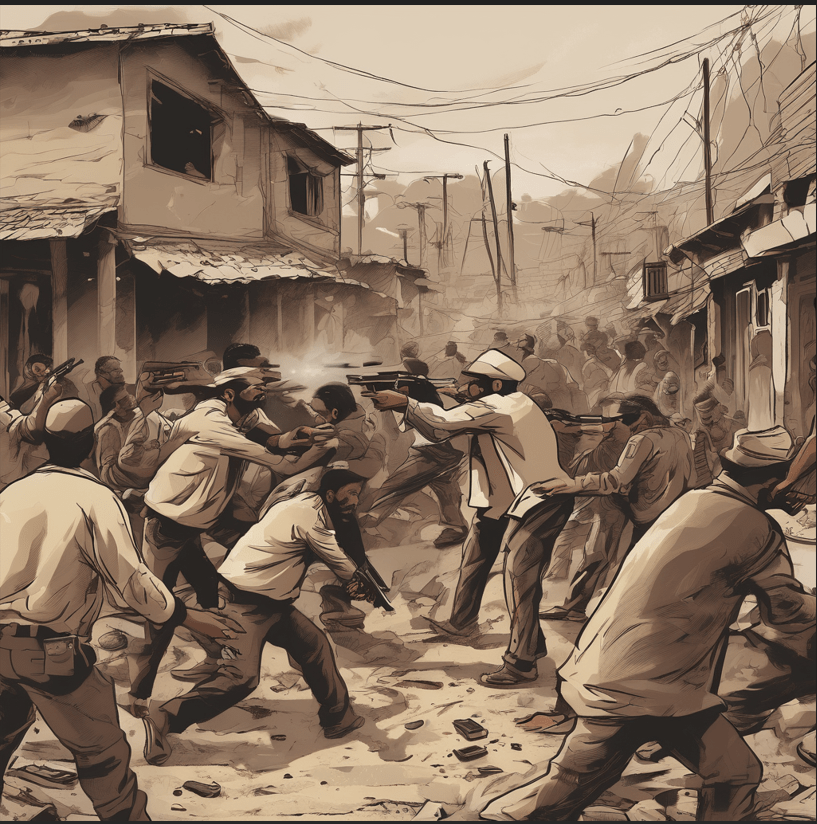
“Well, the goons who had intercepted the Jhargram Police van carrying Wahid to Kuila for reconstructing the crime scene were not there to rescue him. It later came to light that a Babul Islam of Jamshedpur paid them a lakh to put a bullet inside Wahid’s head. Revenge is far more unpredictable than a staged crossfire, my friends,” Sutanu concluded.
(Based on true events in another country)
 Saugata Chakraborty
Leave a comment