(Those who have read ‘Mostly Mundane’ are aware of the Open Letter to the Readers where I have introduced Shanti to the world. That he has been waiting for retribution is pretty evident in the following birthday note I received on WhatsApp this morning. I now only wish more and more people to know what lies beneath that calm demeanour of his.)
My dear Saugata old bean,
Many happy returns of the day! I trust this missive finds you in fine fettle, with a substantial spot of tea and a slice of cake of the most agreeable dimensions within easy reach.
Speaking of agreeable dimensions, I must say, you seem to have captured my own, shall we say, distinctive physique rather well in your tome. Though I do believe I possess a slightly more impressive moustache. A moustache, you might say, with a certain je ne sais quoi, a touch of the rakish, the devil-may-care. You, on the other hand, seem to have saddled me with a rather more… pedestrian model. A bit of a droop, wouldn’t you agree?
But I digress. Birthdays, as I’ve always maintained, are a bit of a rum business. One moment you’re a sprightly young chap, full of beans and whatnot, and the next you’re staring down the barrel of middle age, wondering where it all went wrong. Or, in your case, perhaps wondering where the next plot twist is coming from.
Speaking of which, old boy, I must confess I’m a trifle concerned about this whole “Mostly Mundane” business. I mean, dash it all, a chap likes a bit of excitement in his life, a spot of intrigue, a soupçon of the unexpected. Can’t a fellow trip over a stray cat or encounter a long-lost relative without it being chronicled for all the world to see?
But fear not, my dear Saugata. I shall endeavor to inject a bit of zest into your narrative. Perhaps a daring escapade involving a runaway tramcar and a misplaced pair of trousers? Or a spot of mistaken identity at the local fishmongers? The possibilities, as they say, are endless.
In the meantime, do have a most splendid birthday, and try not to work yourself into too much of a lather. After all, a writer’s life, much like my own, should be one of leisurely contemplation and the occasional stiff drink.
Yours in good spirits (and hopefully a slightly more dashing moustache),
Shantilal Biswas (of Mostly Mundane fame, or infamy, depending on your perspective)
If you’re wondering what this fuss is all about, it’s about time you read about the misadventures of this man of an apparently peaceful disposition. Here’s the link:
The air crackled with festive anticipation, a strange mix of devotion and delirium. Shantilal, still adjusting to the new ruby ring on his finger and the unfamiliar sensation of being a “husband,” trailed behind Anjali, who was navigating the throngs of pandal-hoppers with the determination of an inspired Abhimanyu approaching the Chakravyuh in a saree. He felt like a bewildered yak herded into a kaleidoscope of flashing lights and blaring loudspeakers.
“Ready for some cultural immersion, Shantu?” Anjali chirped, her eyes sparkling with mischief.
Shantilal, a man of quiet contemplation more accustomed to the ordered world of the his government office, merely grunted. He was yet to fully grasp the scale of Durga Puja madness that gripped the city.
Their first stop was a pandal themed “Global Warming: The Fiery Fury of Ma Durga.” A giant papier-mâché thermometer towered over the goddess, its mercury rising ominously. The accompanying pamphlet declared, “This year, Ma Durga battles not Mahishasura, but the demon of rising temperatures!” Shantilal, sweating profusely in the humid pandal, felt a surge of unexpected empathy for the demon.
“This one’s supposed to be amazing, Shanti!” Anjali yelled over the din, her eyes sparkling with excitement. “The theme is ‘Globalization and the Bengali Diaspora’!”
Shantilal winced. He’d hoped for something a bit more… traditional. Maybe a nice, straightforward Durga slaying Mahishasura. Instead, he was confronted with a giant fiberglass globe, precariously balanced on the head of a bewildered looking asura, while miniature figurines of Bengalis in business suits and saris clutching laptops and suitcases sprouted from its continents.
“It’s… something else,” he mumbled, trying to decipher the artistic statement behind a giant papier-mâché NRI brandishing a green card.
The next pandal was even more baffling. “The Existential Angst of the Urban Millennial,” proclaimed a banner in psychedelic colours. Inside, Durga, looking surprisingly morose, was slumped on her lion, staring what appeared to be a giant Blackberry. Asuras, dressed in skinny jeans and sporting man-buns, were glued to their own devices, their faces illuminated by an eerie blue glow.
“Get it?” Anjali nudged him, her voice a mix of amusement and awe. “It’s like, they’re all so connected, yet so alone!”
Shantilal nodded numbly. He felt a sudden urge to escape this madness and find solace in a plate of greasy biryani.
But Anjali was on a mission. “Come on, Shanti! This next one has the theme of “Golden Tradition of Bengal.”
The image of paddy fields getting ready for harvest flashing in Shanti’s inward eye disappeared in a bizarre twist. The “traditional” idol was adorned with real gold jewellery, and the organizers had hired a team of hefty bouncers to stand guard, looking more like they stood inside a bank vault than in a social gathering.
“Apparently, some businessman donated all this jewellery,” Anjali explained, her voice barely audible over the chanting of priests and the clicking of cameras. “They say it’s worth crores!”
Shantilal felt a headache building up. He couldn’t shake off the feeling that the true spirit of the festival was getting lost amidst all the extravagance and commercialism.
As they moved from one pandal to another, the themes became increasingly bizarre. There was another dedicated to global warming, with the demon Mahishasura depicted as a giant carbon footprint. A 100-year old puja showcased the “evils of fast food,” with the demon’s army composed of burgers and fries.
“This is madness,” Shantilal muttered under his breath, as they entered a pandal where the idol was dressed in a replica of a famous Bollywood actress’s outfit in the latest Devdas adaptation.
“Oh, come on, Shanti,” Anjali chided, “It’s all in good fun. Besides, look at the craftsmanship!”
Shantilal sighed. He knew he was fighting a losing battle. He decided to surrender to the chaos, focusing on the delicious street food and the infectious energy of the crowd driving them to the next destination.
The pandal, titled “The Metaphysics of Rosogolla,” was a monstrosity of swirling milk and sugar, with Durga, inexplicably, emerging from a giant vat of the sweet, her expression a mixture of ecstasy and indigestion. Shantilal, his head spinning, felt a deep sense of despair. He longed for the simple days before pujas became platforms for intellectual pretension and artistic one-upmanship.
Exhausted and bamboozled, Shantilal finally stumbled upon a small, unassuming pandal. No grand themes, no philosophical statements, just a simple, serene image of Durga, her eyes radiating strength and compassion. Shantilal felt a wave of relief wash over him.
“This,” he declared, sinking onto a nearby bench, “is what I call a puja.”
Anjali, however, was unimpressed. “It’s a bit… basic, don’t you think?” she said, already scanning the crowd for the next “innovative” spectacle. Shantilal sighed. He realized that this was just the beginning of a lifetime of navigating the chaos of Durga Puja with his intellectually inclined wife. He could only hope that next year, the pandals would feature themes slightly less likely to induce an existential crisis. Perhaps “Durga’s Favourite Fish Recipes” or “The Aerodynamics of Asura Flight.” One could only hope.
“Look, Shantilal!” Anjali exclaimed, pointing towards a pandal that seemed to be constructed entirely out of old computer parts. “Isn’t it innovative? The theme is ‘Cyber Shakti’!”
Shantilal stared at the monstrosity, a giant Durga idol made of motherboards and wires, wielding a mouse instead of a trident. He wondered if this was what religious experiences had come to in the 21st century.
As the night wore on, the lines between reality and fantasy blurred. Shantilal started seeing demons in the shadows and hearing the goddess whisper in his ear. He wondered if he was hallucinating or if the festive madness had finally gotten to him.
As the clock resembled a recliner, they made their way back home. Shantilal’s head was spinning. He collapsed onto the sofa, overwhelmed by the sheer absurdity of it all. Anjali, however, was exhilarated.
“Wasn’t it amazing, Shantu?” she exclaimed. “So much creativity, so much innovation!”
Shantilal, massaging his temples, could only manage a weak smile. “Yes, Anjali,” he sighed. “Truly mind-numbing.”
As he drifted off to sleep, he had a strange dream. He was standing before a giant television screen, where a booming voice announced, “Welcome to Durga Puja: The Ultimate Showdown! Tonight, Ma Durga faces her toughest challenge yet – the bureaucracy!”
Shantilal, jolted awake, felt his ticker do a frantic bhangra. Turning to Anjali, however, he found her sporting the serene expression of a meditating sloth. All his misgivings – poof! – vanished faster than a bureaucrat’s promise. This wasn’t chaos, this was a carnival of the senses! It was Kolkata in its full glory – a glorious mess, utterly unpredictable, like the tamarind water of its ubiquitous phuchkawallas, where you never knew what you were going to get, but somehow, it always worked.
(Note: The mention of Blackberry is natural as Shantilal and Anjlai got married in August, 2004. The Mumbai couple that you may have read about in ‘Mostly Mundane’ spent their first year of marriage in a more laidback Kolkata before making the move to the Maximum City.
Oh! You haven’t read ‘Mostly Mundane’ yet, and have liked Shantilal and Anjali already. Probably, it’s time to catch the couple in their fullest till date. Here’s where you can find them wandering in the Amazon: https://amzn.in/d/9C2FEGZ )
The smoke-filled office of Mostly Mundane Publications was a picture of contrasting emotions. Shantilal, the publisher, exuded an air of unshakeable optimism, while Saugata, the author, resembled a deflated balloon.
“Chin up, old chap!” boomed Shantilal, slapping Saugata on the back with the force of a minor earthquake. “Three days is but a blink in the grand scheme of literary triumphs. The initial frenzy may have subsided, but the seeds of word-of-mouth magic have been sown!”
Saugata, however, remained unconvinced. “Word-of-mouth, Shantilal? It sounds like a desperate plea from a drowning man clinging to a passing twig.”
Shantilal chuckled, his ample belly jiggling like a bowlful of jelly. “Ah, Saugata, your pessimism is as predictable as the English weather. But fear not, my friend, for I have witnessed the power of word-of-mouth firsthand. It is a force more potent than a thousand book reviews, more persuasive than a battalion of marketing gurus.”
“But how can we be sure?” Saugata persisted, his voice tinged with a hint of desperation. “The book has been out for three days, and sales have been… well, let’s just say they haven’t exactly set the world on fire.”
Shantilal leaned back in his chair, a mischievous glint in his eye. “Patience, my dear Saugata, patience. Word-of-mouth is like a slow-burning fuse. It takes time to ignite, but once it does, the explosion is spectacular. Trust me, old chap, Mostly Mundane will soon be the talk of the town, the toast of literary circles, the book everyone is clamoring to read.”
Saugata sighed, his shoulders slumping. “I hope you’re right, Shantilal. I really do.”
“Of course I’m right!” Shantilal declared, his voice booming like a cannon shot. “And when Mostly Mundane conquers the bestseller lists, remember who predicted its triumph. You’ll owe me a crate of the finest scotch, old chap!”
Saugata managed a weak smile. “If that day ever comes, Shantilal, you can have the entire distillery.”
N.B. Those who do not want to let Shantilal lose the opportunity to have his distillery err… distilled water can order their copies of Mostly Mundane at:
The scene opens in Saugata’s cramped study, the air thick with the scent of panic and stale coffee. Saugata, a nervous wreck, is pacing back and forth, his phone clutched in a death grip. Shantilal, the picture of nonchalance, is sprawled on the lone armchair, his feet propped on a teetering pile of manuscript pages.
“Shantilal, this is a disaster!” Saugata wails, his voice reaching an octave that would make a soprano jealous. “The book is out there, but it’s not out there! It’s like a literary Schrödinger’s cat!”
Shantilal yawns, unperturbed. “Yes, yes, I have seen the Hans India today. They have put it up on their Bookshelf. I thought good press on the day of release was what would make you happy.”
Saugata raises his head, his eyes bloodshot. “Shantilal, have you seen Amazon? The book’s not there! People are asking, and all that I can say is that’s the missing link!”
Shantilal chuckles, reaching for a half-eaten samosa on the desk. “Saugata, my friend, relax. A little chaos is good for the soul, and excellent for book sales.”
“Chaos? This is beyond chaos! It’s like we’ve launched a rocket without the fuel!” Saugata sputters, his voice reaching a fever pitch. “And it’s all thanks to that blasted Great Indian Festival on Amazon! They’ve delayed the release, and now we’re stuck in limbo!”
Shantilal leans back in his chair, steepling his fingers. “Think of it as a treasure hunt, Saugata. The readers are the intrepid explorers, and your book is the elusive prize. Besides, a little delay might just build up the anticipation.”
“Explorers? They want to buy the book, not scale Mount Everest to find it!” Saugata explodes, stopping on his tracks. “And anticipation? More like frustration! We’re losing sales to that festival frenzy!”
“Patience, my friend,” Shantilal says calmly. “Remember, you only have made me write that the greatest successes are often born from the most chaotic beginnings. Even Amazon’s festival will end, and then ‘Mostly Mundane’ will have its moment in the sun.” He adds with a wink, “Besides, haven’t you always said you wanted your book to be ‘Mostly Mundane’, but its launch to be anything but?”
Saugata pauses, a reluctant smile tugging at his lips. “You have a point there, Shantilal. But next time, can we aim for ‘Mostly Mundane’ in all aspects, including the launch?”
Shantilal chuckles. “Where’s the fun in that, Saugata? Now is the time to embrace the chaos. It’s where the magic happens. And who knows, this Amazon delay might just turn out to be the best marketing strategy we never planned.”
Saugata is frantically pacing while Shantilal, looking dishevelled as ever, leans nonchalantly on a bookshelf.
SAUGATA:
(Waving his arms) The 15th?! But that’s barely enough time to alert my legions of adoring fans!
Shantilal! This is madness! Utter, complete, absolute madness!
SHANTILAL:
(Raises an eyebrow) Oh, do calm down, my dear Saugata. A little chaos adds spice to life, wouldn’t you agree?
SAUGATA:
(Throws his hands up) Spice?! The release date for ‘Mostly Mundane’ has been moved up two weeks! We’re talking about a seismic shift in the literary landscape! I haven’t even finished polishing my acceptance speech for the inevitable literary awards and you’re talking about spice? SPICE!
SHANTILAL:
(Smooths his moustache) Ah, but isn’t a seismic shift just a grander form of spice? A bit more… potent, perhaps.
SAUGATA:
(Stares incredulously) You… you are unbelievable.
Just then, Suhail, the famous literary agent, enters, looking slightly flustered.
SUHAIL:
What on earth is going on here, Bro? I hear talk of seismic shifts and potent spice…
SAUGATA:
(Turns to Suhail with relief) Oh, thank goodness you’re here! Shantilal seems to think this whole release date fiasco is a minor inconvenience!
SHANTILAL:
(Chuckles) My dear Saugata, you mustn’t fret. The world is eagerly awaiting the chronicles of my exploits. A little change in schedule only heightens the anticipation.
SAUGATA:
(Sighs) Shantilal, while I appreciate your optimism, we have marketing plans, bookstore arrangements…
SHANTILAL:
(Waves a dismissive hand) Details, my friend, mere details. Leave those to the capable hands of Suhail here. I’m certain he’ll navigate this minor turbulence with his usual aplomb.
Shantilal winks at Suhail, then turns and strolls away, whistling a jaunty tune.
SAUGATA:
(Shakes his head) Sometimes, I swear, that man exists solely to test my sanity.
SUHAIL:
(Pats Saugata on the back) Come on, let’s go grab a coffee. And then we’ll figure out how to handle this… seismic shift.
Suhail and Saugata exit for the bookstore cafe, leaving behind a trail of bewildered laughter.
The audit gods continued their mischievous streak with Shantilal. Ink was barely dry on his Muchipara report when a new assignment landed on his desk. This time, fate deposited him in the sleepy town of Dinnaguri in North Bengal, a place famed for its royal palace, its lush green stretches, and a lingering suspicion that the laws of nature bent slightly within its borders.
Shantilal was no stranger to the quirks of small towns, but Dinnaguri was in a league of its own. The designated guest house was a former colonial bungalow, complete with faded portraits of stiff-necked Englishmen that seemed to follow his every move. The first night was an assault on the senses. A raucous frog concert erupted in the overgrown garden, a family of rats squabbled enthusiastically in the ceiling, and a ceiling fan with the ominous wobble of a helicopter about to crash kept him wide awake.
The morning offered little improvement. Dust whirls were a particular Dinnaguri spectacle, locals called them ‘djinns’ – playful spirits with a penchant for wreaking havoc. Shantilal was tasked with auditing the local college’s use of an obscure scholarship fund, and the rambling explanations of the principal had him chewing the end of his pencil into a nervous pulp.
Seeking respite, Shantilal escaped for a walk that afternoon. It was then fate, with its usual disregard for Shantilal’s sanity, intervened. A dust djinn, like a swirling dervish, was heading straight down the road, scattering papers and panicked chickens in its wake. And charging right into its path was a young woman. She was clad in a vibrant sari, her long braid flying out behind her. Plunging straight into the heart of the swirling dust, she vanished for a moment, only to reappear a few steps later clutching a sheaf of what looked like exam papers.
“Silly thing,” she said to herself, tucking the recovered paper into her bag.
Shantilal, utterly baffled yet oddly charmed, found his voice. “That… that was quite dangerous!”
She regarded him with calm amusement. “It wouldn’t be the first time I chased down a runaway exam thanks to these djinns. Children will be children, even when they are made of dust.”
“You… you teach?” He blinked, the image of her fearlessly battling a dust whirl seared into his brain.
“Higher Secondary. English and History.” Her eyes sparkled. “My name’s Anjali.”
Thus began the most peculiar interlude of Shantilal’s life. There were hurried walks between classes, shared cups of tea on a rickety tea-stall bench, and halting conversations that navigated Anjali’s gentle laughter, and Shantilal’s fumbling attempts to decipher the local dialect. He discovered that Anjali was as fierce in the classroom as she was when battling dust whirls, with a passion for literature and an iron will that seemed at odds with her petite frame. His audit became a backdrop to these rendezvous. In Anjali, he found a counterpoint to his ledgers and lists. She taught him to see the town beyond its dusty façade – its vibrant markets, the crumbling remnants of an old fort, the unexpected beauty of sunsets over the tea gardens.
All too soon, his assignment ended. It was time to pack up his ledgers, thermos, and mosquito coils. On his last day, Anjali walked with him to the run-down bus station. There were no grand declarations of affection, no promises etched in stone. Just two shy smiles and a touch of lingering warmth where their hands brushed as she helped him with his eternally battered briefcase.
As the bus rattled away, Shantilal stared out at the blurring green landscape and felt an emotion he hadn’t in years: hope. It was a fluttery, absurd thing, as delicate and unexpected as a butterfly in a ledger book.
Routine tried to reclaim him in Calcutta. But it found him distracted, his curries bland, his ledgers curiously less engaging. Then, one Tuesday, an envelope arrived from Dinnaguri. Its contents? A letter from Anjali, written in a flowing hand. She mentioned an opening for an Accountant, a desperately needed administrative position at the District Inspectorate of Schools. And a subtle hint – wouldn’t a man of his meticulous nature be an asset to their little town?
Shantilal, accountant and accidental romantic, smiled for the first time in weeks. It seemed Dinnaguri, with its djinns, its defiant schoolteacher, and its strangely enchanting chaos, wasn’t quite done with him yet.
(Note: Dinnaguri, like Malgudi can’t be find on the map. That doesn’t mean the rest of the story is imaginary. In ‘Mostly Mundane’, you shall find Shanti and Anjali, years later, in the maximum city of Mumbai. Their journey from Dinnaguri to Mumbai is yet to be chronicled.)
Is your daily grind feeling like a rerun of yesterday’s to-do list? Does the thought of folding laundry make you yearn for a meteor shower? Fear not, weary traveller of the ordinary! Mostly Mundane is here (well, not yet) to inject a shot of laughter into your life that’s stronger than your morning coffee.
This book doesn’t preach about productivity or finding your Zen. It reveals the hilarity hidden in the seemingly mundane aspects of daily life.
From an epic hunt for organic veggies to the existential dread of the never-ending parent-teacher meetings, Mostly Mundane transforms the ordinary into side-splitting adventures. Get ready to laugh out loud and emerge with a fresh perspective that will leave you chuckling at the world- and yourself- in a whole new way (as Tagore on the wall does here)!
[Note: Mostly Mundane is an eagerly awaited {no tall claims there, the author is waiting for it with fish eyes (that is without blinking)} book of 19 odd (without the hyphen, the oddity stands out) slice of life stories from the life of Shantilal and Anjali. The next post in the site would feature the story of their first meeting that got it all started.]
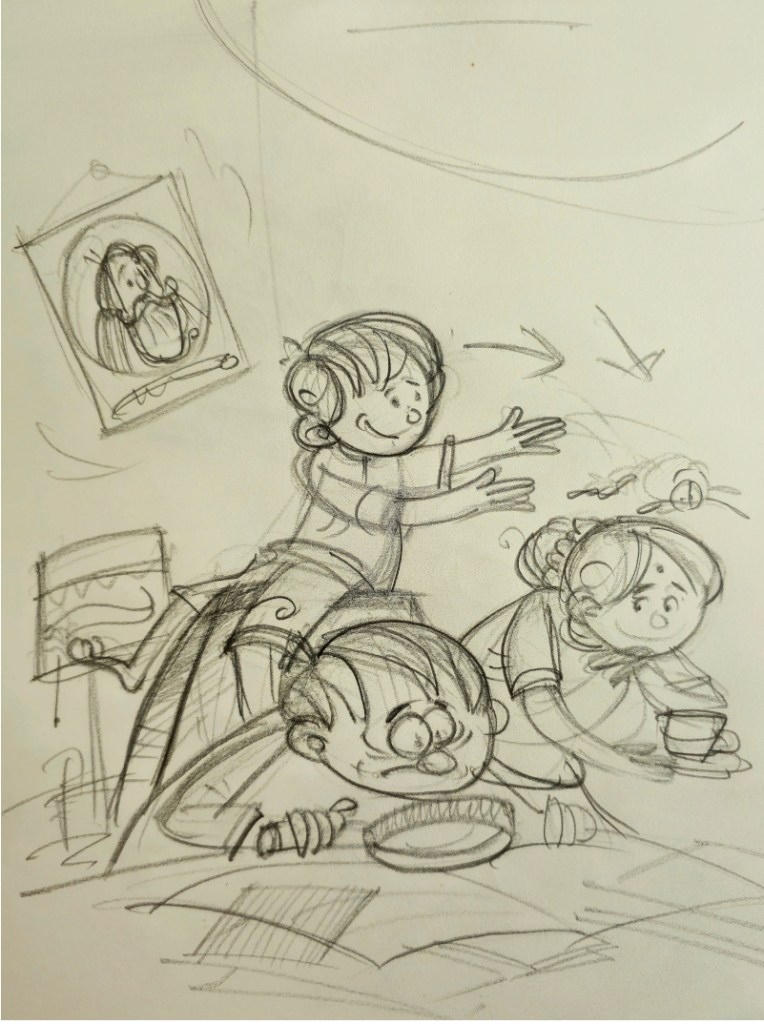
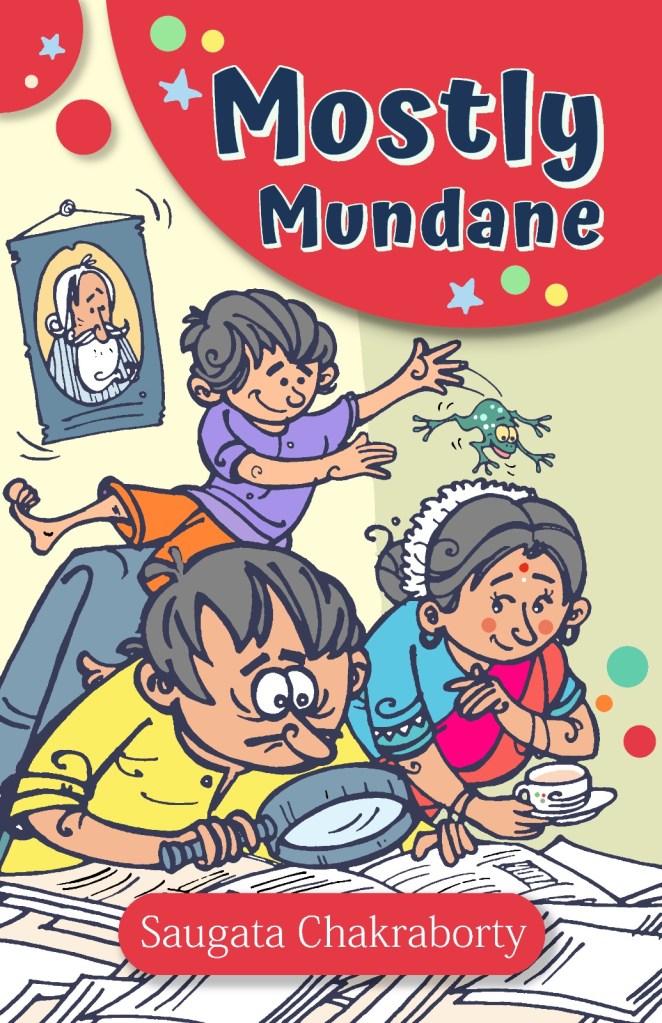
“I would like you to work on the cover of my new book. It’s a humorous account of the life of one Shantilal Biswas, who frequents those facets of life where neither shanti (peace) nor biswas (trust) resides. Shanti and Anjali live in a Mumbai suburb with their 12-year old son Monty (the Mischievous). Would you be interested in doing the work?”
From that first query to this first “rough sketch” for the cover sent over WhatsApp, the three-week journey had only one pit stop- prompt for the cover. It went like this:
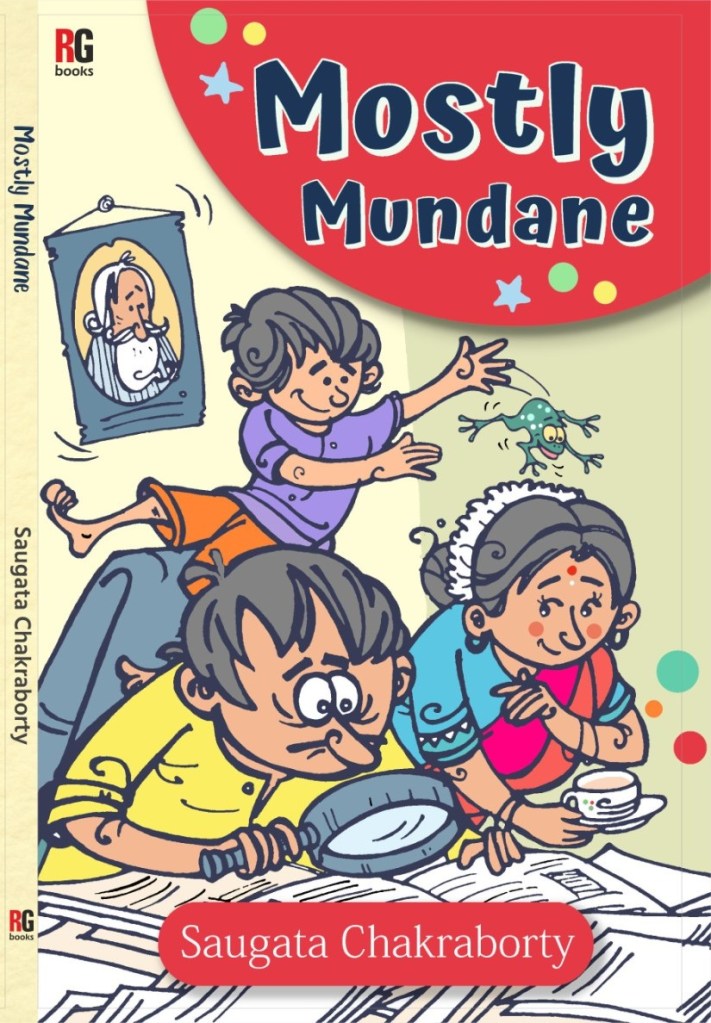
“Cartoon illustration of Shantilal’s family in their suburban Mumbai flat. Monty is seen holding a frog in both his hands, ready to release it on Anjali’s head. She is seen wearing a saree with flowers in her hair bun, carrying a cup of tea to Shanti, who is poring over a bunch of papers with an oversized magnifying glass.”
After Jayanta Biswas quietly changed the overspilling Bournvita into aamchi Mumbai’s cutting chai, and we (me fueled by Anirban Choudhury’s eye for the detail) both agreed on the shadow speed of the text bubble/ ribbon and the glittering celestial objects on the cover, I remembered the requirement of that expensive piece of retail space for displaying the logo of the publisher.
Of course, Redgrab Books, like I suspect not many publishers would, have backed the madness that went beyond ‘Mostly Mundane’ and they fully and any other appropriate adverbially deserved the place in the quietest corner of this raging cover. That they did not leave the back cover to chance or to me
But then, like every good things in life, the cover story also began much before I requested Jayanta to play King Midas. The prompt for the cover came from my significantly better half, Sharmi. Still earlier, the inspiration to create a cover that stands out came from some of the best book covers that I have seen in recent times, designed by the brilliant team at The Book Bakers and the man at the helm of affairs there, India’s best known literary agent these days, Suhail Mathur. Now the world would know who led me to Prayagraj, the home of Redgrab Books.
Shantilal Biswas, a man with the grace of a bull let loose in a porcelain shop, found himself facing a predicament that could rival a Big Bazaar billing counter queue on a Wednesday. An invitation – actually, more of a summons disguised as an invitation – had landed on his desk, demanding his presence in the obscure village of Muchipara. Now, Shantilal was no stranger to obscure villages; his auditing job required him to visit places where chickens crossed the road with more purpose and dignity than humans. But Muchipara was something else entirely.
“Muchipara,” he’d mumbled to himself, rummaging through his dusty atlas for any hint of this godforsaken place. “Is that even in Bengal? Or have they exiled me to Odisha now?”
As it turned out, Muchipara lurked somewhere in the hinterlands of Bengal, a place where, it seemed, electricity arrived on festival days and mobile network coverage was a rumor peddled by optimistic telecom companies. The purpose of his visit? A benevolent society founded by some long-dead zamindar had misplaced some funds (several lakhs worth, as the whispers went), and Shantilal, bless his pedantic soul, was deemed the only accountant trustworthy enough to unearth them.
“As if I don’t have enough troubles chasing vanishing paise in Calcutta” he grumbled, tucking his prized tiffin carrier and a thermos of scalding chai into his worn briefcase.
The journey was an unmitigated disaster. First, there was the train. Not one of those sleek air-conditioned carriages that Shantilal favored on official trips, but an ancient relic that coughed, wheezed, and threatened to derail at every bend. Squashed between a snoring goat herder and a woman with suspiciously pungent pickles, he endured a symphony of snores, bleats, and stomach rumbles. Then came the bus – a ramshackle contraption that defied all known laws of physics and seemed intent on catapulting its passengers into the nearest paddy field.
By the time he reached Muchipara, Shantilal was resembling a less-than-pleased thundercloud. The village was small, the kind where the arrival of a stranger was akin to a solar eclipse. Children peered at him from behind mud walls, dogs barked with alarming enthusiasm, and ancient grandmothers paused their gossip sessions to assess the new spectacle.
He was led to the ancestral home of the zamindar, now converted into the society’s headquarters – a rambling mansion with peeling paint, cobweb-festooned ceilings, and a faint aroma that Shantilal could only attribute to a possible bat infestation. He was greeted by a committee of village elders who seemed to speak a dialect of Bengali only distantly related to the one Shantilal knew. After much bowing, gesticulating, and liberal sprinkling of broken Hindi, he was shown to his room.
It was a chamber of horrors. The bed resembled a medieval torture device, the single window was protected by a rusty mosquito net that looked like it had survived a war, and the solitary lightbulb flickered with a menace that suggested an imminent demise. Shantilal, never known for his stoicism, felt a surge of panic that was not entirely due to the potential insect onslaught.
“Where is the attached bathroom?” he’d demanded, aghast. He had the bladder the size of a pea and was accustomed to civilized plumbing.
More gesticulating, more broken Hindi, and then a revelation that made him want to hop right back on the death-trap bus and return to Calcutta. The bathroom facilities involved a brisk walk to a nearby pond and the dubious privacy of a strategically placed bush. Shantilal’s urban sensibilities reeled in horror.
Dinner was an experience designed to test both his fortitude and his intestines. Curries of unidentifiable ingredients blazed a fiery trail through his system, making him acutely aware of the lack of indoor plumbing. And as the mosquito legions launched their nightly offensive, he discovered that, horror of horrors, he’d forgotten his mosquito coil. Shantilal retired to his torture-bed, slapping ineffectually at the buzzing hordes and cursing the day he’d decided to become an accountant.
The next morning, armed with his ledgers, a fistful of antacids, and grim determination, Shantilal plunged into the investigation. The society’s accounts were a nightmare that would send lesser accountants into paroxysms of despair. Ledgers were missing, receipts were written on scraps of what may have once been banana leaves, and the concept of financial organization seemed as foreign to the committee members as quantum physics.
As days turned into a bewildered blur, Shantilal developed a survival routine. He learned to navigate the treacherous pond-and-bush situation with the steely focus of a commando. He discovered that liberal doses of fiery tea could temporarily quell the volcanic rumblings in his stomach, although their effect on his bladder was questionable. Most importantly, he developed an unlikely friendship with the village postman, a spindly man named Haripada with a fondness for cryptic proverbs and even more cryptic paan stains.
Haripada, bemused by this flustered city-dweller, became Shantilal’s lifeline. He translated the committee’s indecipherable Bengali into something Shantilal could grapple with, procured life-saving mosquito coils, and even introduced him to the culinary salvation that was dim-bhaja (simple, fluffy egg omelets). Turns out, Muchipara had its own strange charms.
Still, the investigation was an uphill battle against both the committee’s chaotic bookkeeping and Shantilal’s rapidly fraying temper.
“Where is the entry for the year the school roof was built?” he’d bellowed, his usually meek voice rising in exasperation one morning. “There must have been a bill from the contractor!”
The committee members blinked, shuffling their feet uneasily. One of them coughed and finally ventured, “Sir, that year, there was a good monsoon. The bamboo for the roof… it grew in our own forest…”
Shantilal stared. “And the labour?”
“Our villagers, Sir. They built it. Community effort.”
Community effort, indeed. His accountant’s heart wept at the blatant disregard for financial protocols. How was he supposed to track expenses that seemingly materialized out of thin air?
One sweltering afternoon, frustration drove him out of the musty mansion and into the village. Shantilal, normally a creature averse to any exertion more strenuous than flipping ledger pages, found himself wandering. Children, finally accustomed to his strange presence, giggled and chased him, trying to poke his generous belly. Beneath a banyan tree, a group of women washed clothes in the pond, their laughter pealing through the air. In a sun-drenched courtyard, an ancient man sat, weaving an impossibly intricate bamboo basket.
And then he saw the school.
It was a small, brick structure, sturdy and modest. Children’s voices drifted out of the open windows, a mishmash of recitation and barely contained chatter. Suddenly, Shantilal understood. The missing ledgers, the seemingly vanished funds – they weren’t lost due to corruption or even incompetence. They were here – in the bricks of the school, the laughter of the children, the intricate weave of the old man’s basket. Muchipara’s currency wasn’t just rupees; it was in bamboo from their forests, in the labour of their hands, in the very fabric of their community.
The revelation hit him with the force of one of Muchipara’s fiery curries. Of course! The problem wasn’t a lack of accountability, it was his way of measuring it.
Back in the mansion-turned-office, Shantilal laid out his new plan. There would still be ledgers, of course. He was an accountant, not a revolutionary. But alongside the entries for building materials and contractor fees, there would be columns for the number of bamboo poles harvested, the donated man-hours, the value of the home-grown vegetables that fed the workers. His ledgers wouldn’t just track money; they would track the heart and soul of Muchipara.
The committee members were hesitant at first. Such a system was unheard of! But Shantilal, emboldened by a newfound respect (and possibly a touch of fondness) for this off-kilter village, persisted. Slowly, meticulously, he translated community spirit into numbers and columns.
(‘Mostly Mundane’ is my upcoming book on the exploits of Shantilal. This story predates all other featuring in the book and is not included. If you find this one to be agreeable to your taste, please let me know on WhatsApp @ +919870071069).







 Saugata Chakraborty